
The tomato leafminer, Tuta absoluta (Meyrick) (Lepidoptera: Gelechiidae) is a pest of great economic importance in several countries in Latin America and the Mediterranean basin. Its primary host is tomato, although potato, aubergine, common bean, physalis and various wild solanaceous plants are also suitable hosts.
Tuta absoluta, synonym Gnoromoschema absoluta (Clarke, 1962), Scrobipalpula absoluta (Povolny, 1964) is characterized by a high reproduction potential. Each female may lay up to 300 creamy-coloured eggs and 10-12 generations can be produced each year. In tomato, it can attack any plant part at any crop stage and can cause up to 100% crop destruction, although the larvae prefer apical buds, tender new leaflets, flowers, and green fruits.
This pest is crossing borders and devastating tomato production in both protected and open fields. Originating from Latin America, T. absoluta has recently spread via infested fruits and packaging material to Europe, North Africa and the Middle East. Given its aggressive nature and crop destruction potential, it has quickly become a key pest of concern in these new geographies.
Damage and Symptoms
Infestation of tomato plants occurs throughout the entire crop cycle. Feeding damage is caused by all larval instars and throughout the whole plant. On leaves, the larvae feed on the mesophyll tissue, forming irregular leaf mines which may later become necrotic. Larvae can form extensive galleries in the stems which affect the development of the plants. Fruit are also attacked by the larvae, and the entry-ways are used by secondary pathogens, leading to fruit rot. The extent of infestation is partly dependent on the variety. Potential yield loss in tomatoes (quantity and quality) is significant and can reach up to 100% if the pest is not managed.
Insect Description and Life Cycle
Tuta absoluta is a micro-lepidopteran insect. The adults are silvery brown, 5-7 mm long. The total life cycle is completed in an average of 24-38 days, with the exception of winter months, when the cycle could be extended to more than 60 days. The minimal temperature for biological activity is 4° C. After copulation, females lay up to 300 individual small (0.35 mm long) cylindrical creamy yellow eggs, which are often found alongside the rachis. Freshly hatched larvae are light yellow or green and only 0.5 mm in length. As they mature, larvae develop a darker green color and a characteristic dark band posterior to the head capsule. Four larval instars develop. Larvae do not enter diapause when food is available. Pupation may take place in the soil, on the leaf surface, within mines or in packaging material. A cocoon is built if pupation does not take place in the soil. 10-12 generations can be produced each year. Tuta absoluta can overwinter as eggs, pupae or adults depending on environmental conditions. Under open-field conditions Tuta absoluta is usually found up till 1000 m above sea level.
High Risk of Insecticide Resistance Development in Tuta absoluta
Risk for Insecticide Resistance Development:
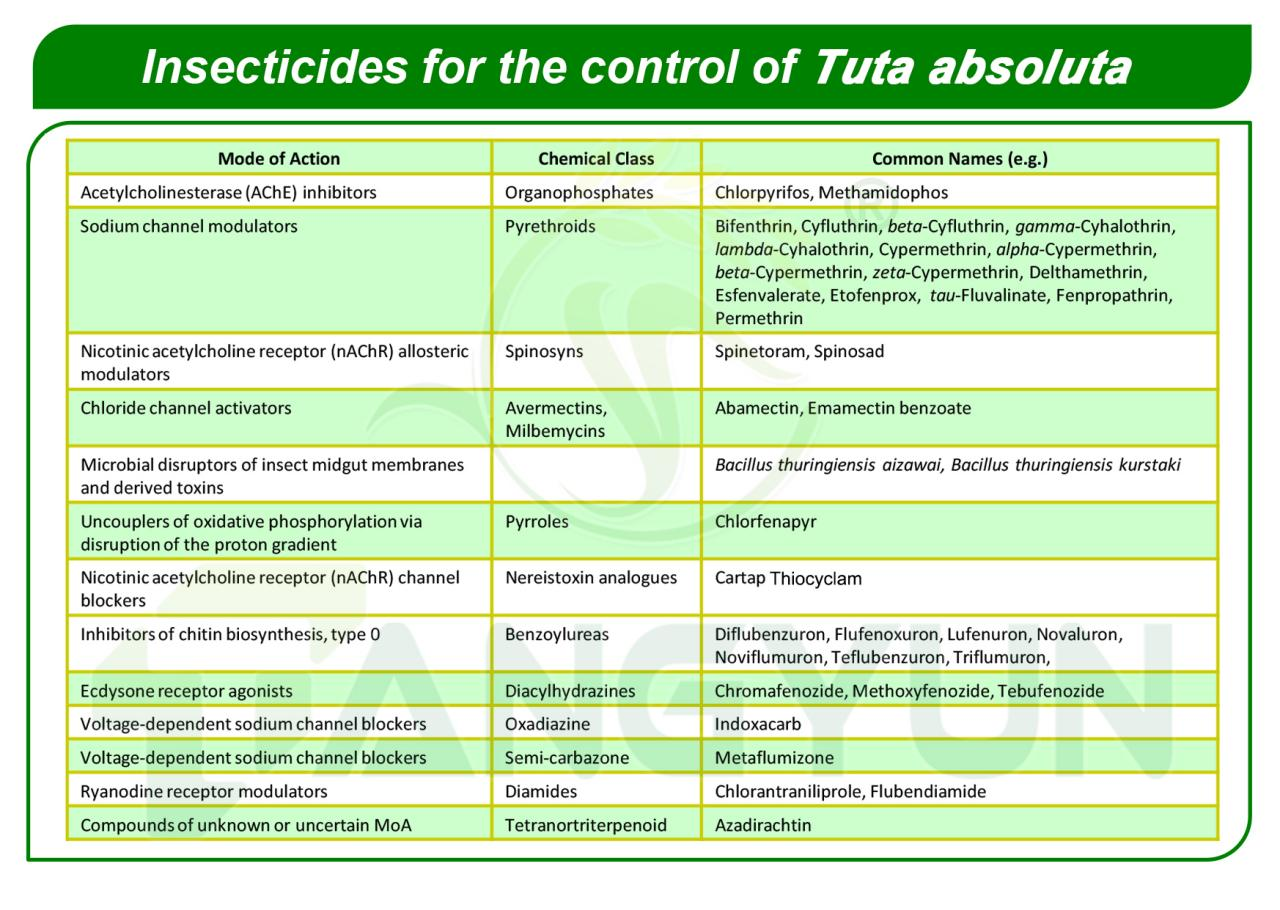
Pests like Tuta absoluta, with high reproduction capacity and short generation cycle, are at higher risk of developing resistance to insecticides. This risk increases significantly when management of the pest relies exclusively on chemical control with a limited number of effective insecticides available. This situation usually leads to an increase in the frequency of use and thus, increased selection pressure for resistance. T. absoluta has been a key pest in tomato in Latin America for decades and is resistant to a range of mode of action groups. Because of this resistance history, it is possible that introduced populations may express the same resistance profiles as found in Latin America.
Key Management Strategy – Integration of Control Measures
1. Allow a minimum of 6 weeks from crop destruction to planting the next crop to prevent carry-over of the pest from the previous crop.
2. Between planting cycles, cultivate the soil and cover with plastic mulch or perform solarisation.
3. Control weeds to prevent multiplication in alternative weed hosts (especially Solanum, Datura, Nicotiana).
4. Before transplanting, install sticky traps.
5. Use pest-free transplants.
6. Seal the greenhouse with high-quality nets suitable for T. absoluta.
7. Place pheromone-baited traps to monitor all stages of tomato production, i.e., nurseries, farms, packaging, processing, and distribution centers. Start monitoring 2 weeks before planting.
8. Inspect the crop to detect the first signs of damage.
9. As soon as more than 3-4 moths per trap are captured each week, start mass trapping of moths.
10. For mass trapping of moths, use sticky traps or water + oil traps (20-40 traps/ha) baited with pheromone.
11. Keep using pheromone traps for at least 3 weeks after removing the crop; this catches remaining male moths.
12. Remove and destroy attacked plant parts.
13. Establish populations of effective biological control agents (e.g., Nesidiocoris tenuis, Necremnus, Trichogramma, Macrolophus, Pseudoapanteles, Podisus, Nabis /Metarhizium).
14. Use locally established thresholds to trigger insecticide applications.
15. Select insecticides based on known local effectiveness and selectivity.
16. Use only insecticides registered for control of T. absoluta or lepidopteran leaf miners and always follow the directions for use on the label of each product.
17. Maintain population levels below economic threshold.
Post time: Apr-01-2026

