
Thrips are a large group of insects with over 6,000 species. They can become serious pests in gardens, greenhouses, and indoor growing areas. While many thrips feed on a wide range of plants, some species prefer certain plant families.
Both adult and immature thrips feed on leaves and flowers, causing damage quickly. Common signs include leaf stippling, silvery patches, discoloration, and distorted new growth. In ornamental plants, pollen and frass buildup can also be a problem because it reduces flower quality and appearance.
Identification and Life Cycle
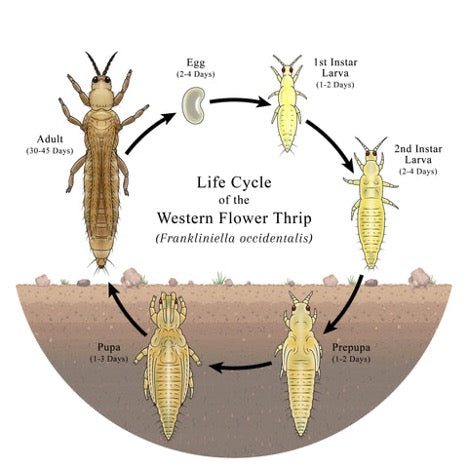
Thrips are tiny yet easy to spot with slender bodies and delicate, fringed wings. Species identification is hard, but their host plants offer clues. As hemimetabolous insects, they have four distinct life stages with nymphs resembling adults:
Egg: Microscopic eggs embedded in leaves, buds, and stems, hard to spot; mature into adults in 14 days.
Larva: White/yellow newly hatched larvae feed on plant cells right away.
Pupa: Pupation happens in soil or plant litter; some spin silk cocoons, barely visible.
Adult: Winged or wingless mobile adults spread fast and breed constantly to repeat the cycle, varying with seasons and surroundings.
Thrips Control:
1. Monitoring & Prevention:
Thrips Monitoring & Biological Control
Check plants frequently for thrips damage early. Place blue/yellow sticky traps to track populations; blue traps suit areas with beneficial insects.
Biological Controls (ideal for mild thrips infestations)
1. General predators (minute pirate bugs, green lacewings, ladybugs) suppress thrips numbers. Fungal biopesticides target all thrips life stages.
2. Beneficial nematodes kill soil thrips to cut reproduction and adult populations.
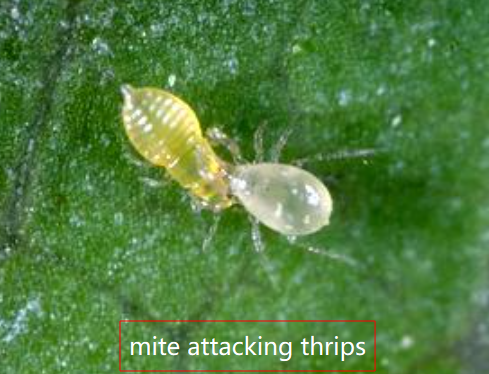
3. Amblyseius cucumeris mites eat young thrips and other mites; release 6–8 weeks before heavy outbreaks.
4. Amblyseius swirskii controls thrips and breeds faster at 77–85°F, 70% RH.
5. Stratiolaelaps scimitus preys on soil thrips prepupae and pupae.
3. Insecticide Sprays:
It is generally recommended to follow the formula “fast-acting contact killer + systemic long-lasting insecticide + egg-killing agent.” Based on the local thrips resistance level, choose the right products, mix them properly, and spray thoroughly over every part of the crop, especially hidden areas such as flower buds and the undersides of leaves. This approach can usually keep thrips populations under control. Insecticides with different modes of action should be used alternately or in combination.
1. Organophosphate insecticides
Examples include DDVP, malathion, dimethoate, and chlorpyrifos.
These have very strong contact-killing effects.
Thrips die quickly after contacting the pesticide, and these products also have strong fumigant activity. Even thrips hiding on the underside of leaves or in flower bud crevices can be controlled through fumigation, so the insect-killing speed is very fast.
2. Spinosad
This works through both contact and stomach poisoning.
It has good insecticidal performance and is relatively safe to use.
3. Chlorfenapyr
This also acts through contact and stomach poisoning and has no systemic activity.
However, thrips have developed strong resistance to it in recent years, so it is no longer very effective when used alone. It is better to combine it with other insecticides.
4. Neonicotinoids
Examples include thiamethoxam, dinotefuran, and clothianidin.
These have very strong systemic activity and can be used in flexible ways: foliar spray, root drench, or granular application.
If thrips are especially hard to control and foliar spraying is not effective, switch to root drenching or granular application. The active ingredient will be absorbed through the roots and transported throughout the plant. No matter where the thrips are hiding, they will die once they feed on the plant sap, making the control effect very obvious.
5. Spirotetramat
This is also a very good systemic and long-lasting insecticide.
It not only provides extended pest control but also has some inhibitory effect on thrip eggs. It is practical because one product can provide both long-lasting control and partial egg suppression.
6. Specialized egg-killing insecticides
Examples include Pyriproxyfen and Tolfenpyrad.
Post time: Jun-24-2026

