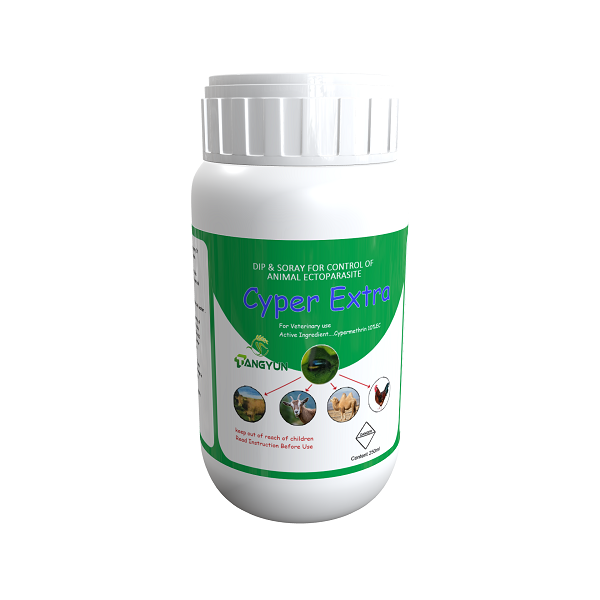
Cypermethrin


Tech Grade: 96%TC
|
Formulations |
Target |
Dosage |
| Cypermethrin50g/LEC | Cotton bollworm | 1500-1800ml/ha |
| Cypermethrin25%EW | Cotton bollworm | 360-480ml/ha |
| Cypermethrin8%CS | Longhorn beetle | 10ml within 2-3L water |
| Cypermethrin10%ME | Cabbage worm | 300-450ml/ha |
| Cypermethrin10%WP | Bed bugs, ants, mosquitoes, flies, cockroaches | 100ml within 4-5Lwater |
| Cypermethrin2%+abamectin0.1%EC | Diamondback moth | 750-1050g/ha |
| Cypermethrin0.8%+dichlorvos8.8%+phoxim3.2%EC | Mosquitoes, flies | 10ml within 1L water |
| Cypermethrin6%+tetramethrin2%EC | Mosquitoes, flies, cockroaches | 0.6g/100㎡ |
| Cypermethrin8%+imidacloprid2%EC | Aphids | 225-300ml/ha |
| Cypermethrin40g/L+profenofos400g/LEC | Cotton bollworm | 1200-1500ml/ha |
| Cypermethrin5%+dichlorvos38%EC | cabbage caterpillar | 174-348ml/ha |
| Cypermethrin5%+chlorpyrifos50%EC | Cotton bollworm | 750-1200ml/ha |
| Cypermethrin3%+petroleum oil30%EC | Aphids | 600-900g/ha |
| Cypermethrin2%+triazophos18%EC | Cotton bollworm | 1500-1800ml/ha |
| Cypermethrin2%+phoxim38%EC | Cotton bollworm | 450-600g/ha |
| Cypermethrin3%+emamectin benzoate0.2%ME | Beet armyworm | 750-900ml/ha |
| Cypermethrin2%+tetramethrin3%SC | Mosquitoes | 30-60 mg/m³ |
| Cypermethrin0.2%+thiram5%+tebuconazole0.8%FS | Head smut | Pesticide-to-seed ratio: 1:50–60 |
| Cypermethrin8.5%+abamectin0.3%WP | Diamondback moth | 450-600g/ha |
| Cypermethrin9%+acetamiprid1%EC | Woolly aphid | 10ml within10L-20L water |
| Cypermethrin0.15%+permethrin0.15%EW | Mosquitoes | 67g/㎡ |
| Cypermethrin3%+thiram10%FS | Cutworm | 1669–2500 mL/100 kg seeds |
Applicaton:
1. Cotton
Target Pests: Cotton bollworm, American bollworm, Pink bollworm, Cotton aphid.
Application Method: Foliar spray.
PHI: 7 days.
Notes: Apply at the peak stage of egg hatching and till the young larvae stage. Use higher rates under heavy pest pressure.
2. Vegetables (Cruciferous and Others)
Cruciferous vegetables, including various cabbage varieties, are a key target for cypermethrin use.
Target Pests: Cabbage caterpillar, Diamondback moth, Aphids, Leafhoppers.
Application Method: Foliar spray.
PHI: 5-7 days.
Notes: This product is toxic to silkworms, so it should not be used near mulberry orchards.
3. Fruit Trees (Pome and Stone Fruits, Citrus)
Cypermethrin is widely used to control various lepidopteran pests in orchards, but it has a long pre-harvest interval.
Target Pests: Peach fruit borer, Codling moth, Citrus leaf miner, Red wax scale, Aphids.
Application Method: Foliar spray.
PHI: 21 days for apples, 40 days for citrus, 14 days for pomegranates.
Notes: Do not spray during the flowering period. Rotation with other classes of insecticides is recommended to delay resistance.
4. Tea
Target Pests: Tea lesser leafhopper, Tea geometrid.
PHI: 7 days.
Notes: Do not apply more than once per season. This product is highly toxic to aquatic life.
5. Tobacco
Target Pests: Tobacco budworm.
Application Method: Foliar spray.
PHI: 15 days.
Notes: Apply during the young larvae stage.
6. Grain Crops (Wheat, Corn, Sorghum)
Target Pests: Stink bugs, borers, aphids.
Application Method: Foliar spray.
PHI: Generally 30 days (Check label).
Notes: Use the lower rate for light to moderate infestations.
Cautions:
Resistance Management: Cypermethrin belongs to IRAC Group 3A. Rotate it with insecticides from other groups (e.g., organophosphates, carbamates, or spinosyns) to delay resistance.
Phytotoxicity & Timing: While generally safe, avoid spraying under extreme heat or drought stress. Apply when pests are most vulnerable (e.g., young larvae, egg hatch period). Do not apply if rain is expected within 1 hour.
Safety Precautions: This product is highly toxic to bees, fish, and silkworms (aquatic invertebrates). Do not apply to crops during bloom where bees are foraging, near aquatic environments, or near mulberry orchards.
PHI & Re-entry: Adhere strictly to the Pre-Harvest Interval (PHI) listed for each crop. The Restricted Entry Interval (REI) is generally 12-24 hours.