
I. What is it
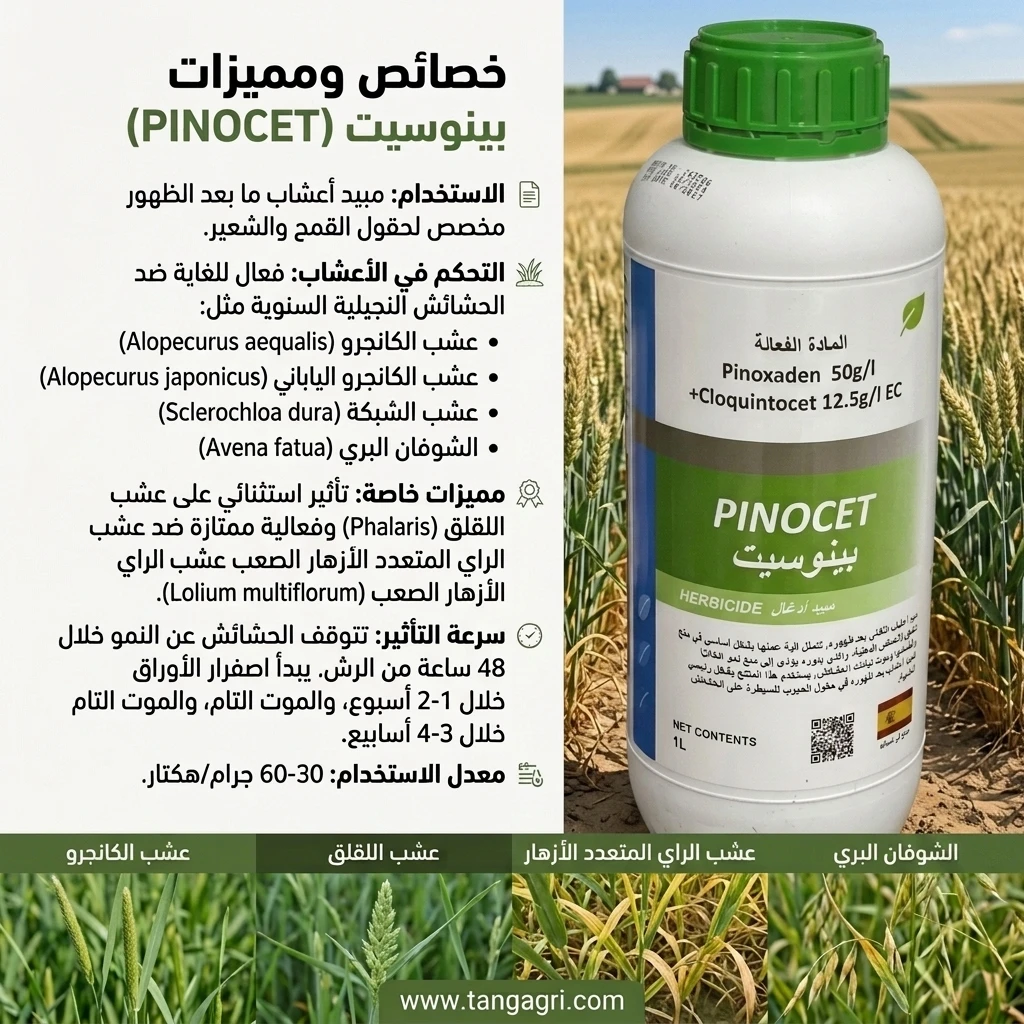
Pinoxaden is a post-emergence selective herbicide specifically for wheat and barley fields, belonging to the new generation of ACCase inhibitors.
Unlike older products commonly found on the market such as quizalofop-p-ethyl and clodinafop-propargyl,
it belongs to the neophenylpyrazoline class in chemical structure and has no cross-resistance with older products.
II. What problems does it solve
Pinoxaden specifically targets the most troublesome annual grass weeds in wheat fields, including:
- Shortawn Foxtail, Alopecurus japonicus
- Wild Oat.
- Keng Stiffgrass, American Sloughgrass, Polypogon fugax.
- Italian Ryegrass (highly effective)
- Canary Grass (highly effective)
III. What are its advantages?
3.1 Application window: 3-leaf stage to pre-heading stage
3.2 Relatively good low-temperature tolerance
3.3 Safety to barley
3.4 Safe for subsequent crops, rapid degradation, does not affect the next crop
IV. How to use it effectively
Optimal Timing: Weeds at the 2-5 leaf stage, and wheat seedlings after the 3-leaf stage.
Dosage: 1050-1200 ml per hectare for winter wheat fields, diluted with water and sprayed evenly on the stems and leaves.
V. Common Questions
Q: How many days after application will it be effective?
A: Weeds will stop growing in about 2 days, begin to turn yellow in 2-3 weeks, and die completely in 3-4 weeks.
Don’t rush to see the dead weeds; give them time.
Q: Can it be applied together with broadleaf herbicides?
A: Not recommended. It’s best to apply them separately, with an interval of at least one week.
If you must mix them, test on a small area first.
Q: Will it affect subsequent crops like corn and soybeans?
A: No. Pinoxaden degrades quickly in the soil and does not affect subsequent crops.
Q: Can it control Tausch’s goatgrass?
A: No. It needs to be used in conjunction with mesosulfuron-methyl, or an alternative treatment.
 Pinoxaden
Post time: Jul-08-2026

