
Spirotetramat 22.4%SC


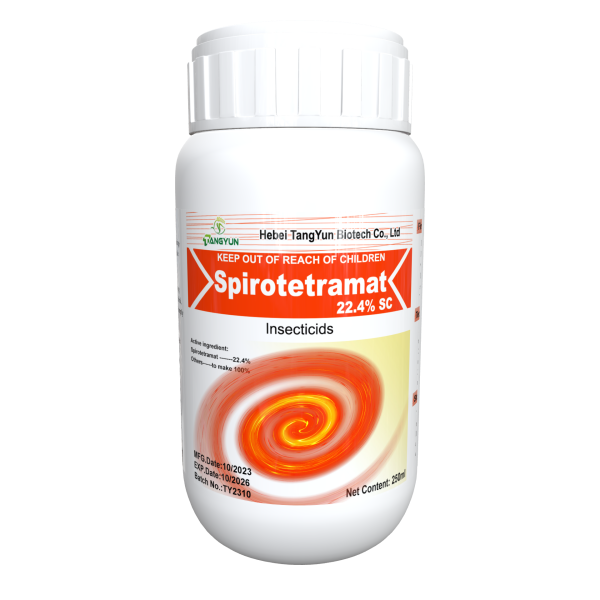
Tech Grade: 96%TC
| Formulations | Target | Dosage |
| Spirotetramat 22.4% SC | red spider | 4000–5000-fold dilution |
| Spirotetramat 80%WDG | thrips | 90-120g/ha |
| Spirotetramat 150g/L OD | thrips, aphids | 2250-2625ml/ha |
| Spirotetramat 15%+Thiacloprid 15% SC | sweet potato whitefly | 375-525ml/ha |
| Spirotetramat 10%+Dinotefuran 20% SC | sweet potato whitefly | 225-300ml/ha |
| Spirotetramat 15%+Dinotefuran 15% OD | sweet potato whitefly | 300-375ml/ha |
| Spirotetramat 30%+Dinotefuran 30% WDG | sweet potato whitefly | 150-180g/ha |
| Spirotetramat 24%+Abamectin 4% SC | pear psylla | 4000–6000-fold dilution |
| Spirotetramat 13%+Buprofezin 26% SC | scale insects | 2500-4500-fold dilution |
| Spirotetramat 24%+Flonicamid 16% SC | thrips | 225-270ml/ha |
| Spirotetramat 14%+Bifenazate 28% SC | red spider | 3500–4000-fold dilution |
| Spirotetramat 30%+Etoxazole 15% SC | red spider | 8000–10000-fold dilution |
| Spirotetramat 15%+Pyriproxyfen 15% SC | scale insects,psyllid | 3000-5000-fold dilution |
| Spirotetramat 10%+-Pyriproxyfen 10% OD | sweet potato whitefly | 525-825ml/ha |
| Spirotetramat 15%+Thiamethoxam 22.5% SC | aphids | 4000-6000-fold dilution |
| Spirotetramat 30%+Ivermectin 2% SC | pear psylla | 4000-6000-fold dilution |
| Spirotetramat 10%+Imidaclothiz 15% SC | greenhouse whitefly | 180-225ml/ha |
| Spirotetramat 25%+Deltamethrin 5% SC | aphids | 150-180ml/ha |
| Spirotetramat 10%+Tolfenpyrad 20% SC | rust mite | 4500-5000-fold dilution |
| Spirotetramat 10%+Clothianidin 20% SC | scale insects | 2000-3000-fold dilution |
| Spirotetramat 12%+Afidopyropen 3% ME | sweet potato whitefly | 600-750ml/ha |
| Spirotetramat 300g/L+Tetraniliprole 120g/L SC | leaf miner moth | 6000-7500-fold dilution |
| Spirotetramat 20%+Acetamiprid 10% SC | psyllid | 4000–5000-fold dilution |
| Spirotetramat 10%+Thiocyclam-hydrogenoxalate 25% OD | thrips | 750-900ml/ha |
| Spirotetramat 25%+Pymetrozine 30% WDG | aphids | 150-180g/ha |
| Spirotetramat 10%+Pymetrozine 20% SC | sweet potato whitefly | 300-450ml/ha |
| Spirotetramat 17%+Chlorfenapyr 8% SC | thrips | 300-450ml/ha |
| Spirotetramat 21%+Fenpyroximate 9% SC | red spider | 4000–5000-fold dilution |
| Spirotetramat 11%+Imidacloprid 11% SC | scale insects | 3700-4500-fold dilution |
| Spirotetramat 15%+Imidacloprid 35% WDG | aphids | 45-75g/ha |
| Spirotetramat 22%+Bifenthrin 8% SC | scale insects | 3200-4000-fold dilution |
| Spirotetramat 15%+Fenbutatin oxide 20% SC | red spider | 3000-4000-fold dilution |
| Spirotetramat 8%+Chlorpyrifos 32% SC | red wax scale | 1500–2000-fold dilution |
| Spirotetramat 10%+Chlorpyrifos 30% EC | scale insects | 2000-3000-fold dilution |
Application:
1.Potato: Apply before aphid or psyllid populations build up. Apply two sequential applications 10-14 days apart. The safety interval is 7 days, and no more than 2 uses per growing season .
2.Citrus: Apply at first crawler movement (80-100% petal fall). For two-treatment program, apply 10 ml/100L and repeat 4 weeks later. For mealybug, apply 30-40 ml/100L plus mineral oil. The safety interval is 21 days .
3.Grapes: Apply first treatment when inflorescences are clearly visible until fully developed (approx. 25-30 cm shoot length). Apply follow-up treatment approximately 6 weeks later at pea-berry stage. Minimum spray interval of 30 days. The safety interval is 28 days .
4.Brassica Vegetables: Apply at early pest infestation stage. The safety interval is 1-3 days, and no more than 2 uses per growing season .
5.Bulb Vegetables (Onion, Leek, Garlic): Apply for onion thrips larvae. The safety interval is 3 days, and no more than 2 uses per growing season .
Cautions:
Each crop can be used up to 2 times per growing season to avoid resistance development . The safety interval varies by crop: 1-3 days for vegetables, 7 days for potatoes, 21 days for citrus, and 28 days for grapes .
Do not apply prior to petal-fall on pome fruits, stone fruits, and tree nuts as sufficient leaf tissue must be present for uptake .
This insecticide is very toxic to aquatic life and cannot be directly sprayed on water or water sources . Do not contaminate wetlands or watercourses with this product or used containers. Leave buffer zones around aquatic systems .
Phytotoxicity has occasionally been observed in protected cropping environments . Not recommended for use on sensitive crops without prior testing.


