Fomesafen



Tech Grade: 98%TC
|
Formulations |
Target |
Dosage |
|
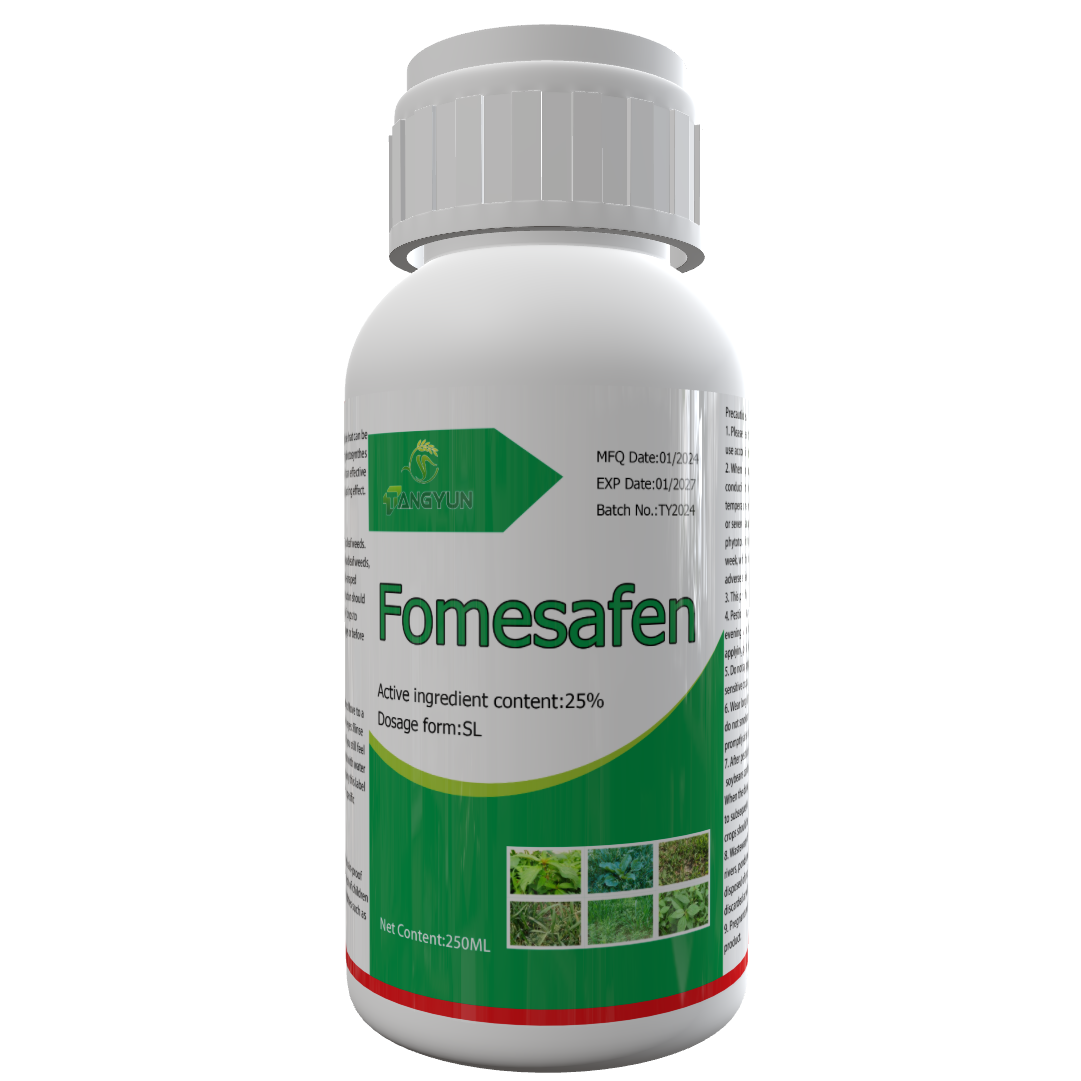
Fomesafen25%SL |
Annual broadleaf weed |
1200-1500mll/ha |
|
Fomesafen 20%EC |
Annual broadleaf weed |
1350-1650ml/ha |
|
Fomesafen 12.8%ME |
Annual broadleaf weed |
1200-1800ml/ha |
|
Fomesafen 75%WDG |
Annual broadleaf weed |
300G-400g/ha |
|
Fomesafen 90%SP |
Annual broadleaf weed |
225-300g/ha |
|
Fomesafen11%+Clomazone20%+haloxyfop-P-methyl4%OD |
Annual broadleaf weed |
1650-1950ml/ha |
|
Fomesafen11.8%+haloxyfop-P-methyl2.2%OD |
Annual weed |
2250-3000ml/ha |
|
Fomesafen17%+Clethodim 4%OD |
Annual broadleaf weed |
1500-2250ml/ha |
|
Fomesafen11%+Clomazone15%+clethodim7%OD |
Annual broadleaf weed |
1725-2025ml/ha |
|
Fomesafen11%+Clomazone23%+Clethodim5%EC |
Annual broadleaf weed |
1500-1800ml/ha |
|
Fomesafen12%+Clomazone20%+haloxyfop-P-methyl 5%EC |
Annual broadleaf weed |
1200-1500ml/ha |
|
Fomesafen12%+Quizalofop-P-ethyl3%EC |
Annual broadleaf weed |
1500-2100ml/ha |
|
Fomesafen12.5%+Sethoxydim8.3%EC |
Annual broadleaf weed |
2100-2250ml/ha |
|
Fomesafen10%+Bentazone 44%SL |
Annual broadleaf weed |
1350-1650ml/ha |
|
Fomesafen25%+Fluoroglycofen-ethyl 5%SL |
Annual broadleaf weed |
600-900ml/ha |
|
Fomesafen21%+Imazethapyr4%SL |
Annual broadleaf weed |
1500-1800ml/ha |
|
Fomesafen9%+Bentazone20%+Imazethapyr3%SL |
Annual broadleaf weed |
2100-2400ml/ha |
|
Fomesafen16%+Quizalofop-P-ethyl 4%ME |
Annual broadleaf weed |
1200-1800ml/ha |
|
Fomesafen12.5%+Sethoxydim 8.3%ME |
Annual weed |
130-150ml/ha |
|
Fomesafen22%+Clethodim8%ME |
Annual weed |
750-1050ml/ha |
|
Fomesafen12.5%+Sethoxydim 8.3%ME |
Annual weed |
1950-2250ml/ha |
|
Fomesafen5%+Bentazone21%+Acifluorfen3%SL |
Annual broadleaf weed |
2100-2400ml/ha |
|
Fomesafen5%+Clomazone 15%+Quizalofop-P-ethyl5%SL |
Annual broadleaf weed |
1650-1950ml/ha |
|
Fomesafen5%+Bentazone14.5%+Quizalofop-P-ethyl1.5%SL |
Annual broadleaf weed |
2760-3000ml/ha |
|
Fomesafen6%+Bentazone11%+Imazethapyr1%SL |
Annual broadleaf weed |
3750-4200ml/ha |
|
Fomesafen14%+Bentazone68%WP |
Annual broadleaf weed |
1350-1500g/ha |
Applicaton:
1. Soybeans (Spring Sowing): Apply at the 1-2 trifoliate leaf stage of soybeans when most weeds have emerged and are at the 2-4 leaf stage . Apply 60-100 ml per mu (900-1500 ml/ha) for spring soybeans . The preharvest interval (PHI) is 60 days . Use no more than 1 application per growing season . Some bronzing or crinkling of soybean leaves may occur after application, but plants outgrow these effects within 5-7 days without yield loss .
2. Soybeans (Summer Sowing): Apply at the 1-2 trifoliate leaf stage of soybeans when most weeds have emerged and are at the 2-4 leaf stage . Apply 50-60 ml per mu (750-900 ml/ha) for summer soybeans . The preharvest interval (PHI) is 60 days . Use no more than 1 application per growing season . For best results, apply with 40 liters of water per mu (600 L/ha) .
3. Cotton: Apply preplant surface, preemergence, and/or postemergence for control of broadleaf weeds, grasses, and sedges . Apply as a directed spray to avoid contact with cotton foliage. Thorough spray coverage is essential for effective control as the product works through contact action . Consult local labels for specific dosage rates.
4. Dry Beans / Snap Beans: Apply preplant surface, preemergence, and/or postemergence for control of broadleaf weeds, grasses, and sedges . Moisture is necessary to activate the product in soil for residual weed control. Postemergence applications require thorough coverage of emerged weeds .
5. Potatoes: Apply preplant surface, preemergence, and/or postemergence for control or suppression of broadleaf weeds, grasses, and sedges . For postemergence applications, apply to young, actively growing weeds that are not under stress.
Cautions:
Application timing: Apply post-emergence when weeds are at the 2-4 leaf stage for optimal control . For soybeans, apply at the 1-2 trifoliate stage .
Rainfast period: This product is rainfast within 1 hour after application . It can also be effective if rainfall occurs 4-6 hours after treatment .
Maximum use per season: Do not apply Fomesafen to the same field more than once every two years to manage resistance and soil residue . Apply no more than once per growing season .
Restrictions on stressed plants: Do not apply to weeds or crops under stress conditions such as drought, low temperature, waterlogging, or low fertility, as this reduces efficacy and may increase crop injury risk .
Crop rotation intervals (replanting restrictions): Fomesafen can persist in soil for 1-4 months .
Drift management: Do not apply on windy days or when rain is expected. Prevent the pesticide solution from drifting onto adjacent sensitive broadleaf crops or non-target areas . Apply in the morning or evening when conditions are calm .
Mixing restriction: Do not mix with alkaline pesticides as this may cause decomposition and reduced efficacy .