
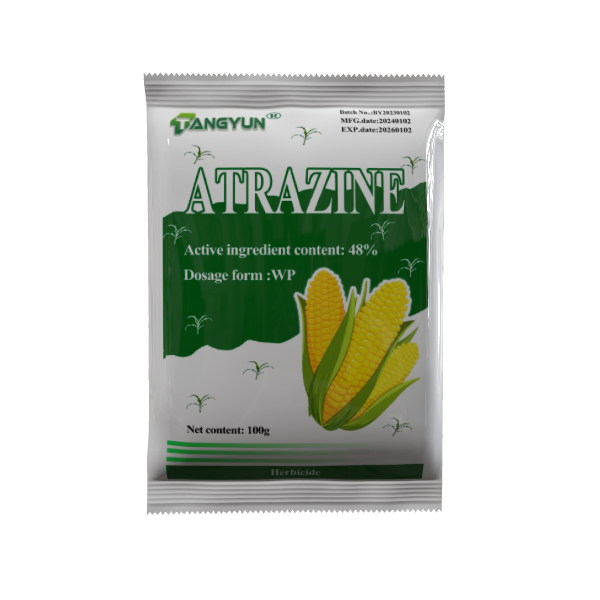
Atrazine

Short Description:

Mode of Action of Atrazine:

Systemic herbicide with selective pre-emergence and post-emergence activity.

Atrazine works by inhibiting photosynthesis (photosystem II – PSII inhibitor, HRAC/WSSA Group 5), blocking electron transport in plant chloroplasts, which leads to starvation and death of susceptible weeds.

Key Properties / USPs:

1. Excellent pre-emergence and early post-emergence control of broadleaf and grass weeds

2. Long-lasting residual activity in soil – provides extended weed control

3. Absorbed primarily through roots and shoots, with translocation via xylem

4. Effective at moderate application rates, offering cost-effective weed management

5. Compatible with many other herbicides for broad-spectrum tank mixes

6. Suitable for use in conservation tillage and no-till farming systems

7. Broad-spectrum activity – Annual broadleaf weeds and certain annual grasses

8. Reliable performance in corn (maize), sugarcane, sorghum, and other tolerant crops

Typical Use Crops:

Corn / Maize (broadleaf and grass weeds)

Sugarcane (broadleaf weeds)

Sorghum (broadleaf and grass weeds)

Pineapple (broadleaf weeds)

Turf and non-crop areas (industrial weed control)


  • Packaging and Label: Providing customized package to meets customers various requirements
  • Min.Order Quantity: 1000kg/1000L
  • Supply Ability: 100 Ton per Month
  • Sample: Free
  • Delivery Date: 25days-30days
  • Company Type: Manufacturer
  • Product Detail

    Product Tags

    Tech Grade: 98%TC

    Formulations

    Target

    Dosage

    Atrazine 80%WP

    Annual weeds

    1500-2250 ml/ha

    Atrazine 90%WDG

    Annual weeds

    1500-2250 ml/ha

    Atrazine 50%+mesotrione 5%SC

    Annual weeds

    1800-2400 ml/ha

    Atrazine 21%+Atrazine 5%SC

    Annual weeds

    1200-1500 ml/ha

    Atrazine 20%+mesotrione 6%+nicosulfuron 4% OD

    Annual weeds

    1200-1500 ml/ha

    Atrazine 22%+bromoxynil octanoate 13%+nicosulfuron 3% OD

    Annual weeds

    1500-1800 ml/ha

    Atrazine 15%+alachlor 2%+acetochlor 25% SE

    Annual weeds

    2250-3000 ml/ha

    Atrazine 20%+nicosulfuron 2%+propisochlor 15% OD

    Annual weeds

    2250-3000 ml/ha

    Atrazine 24%+Acetochlor 28%+ isoxaflutole 3% SE

    Annual weeds

    3000-3375 ml/ha

    Atrazine 25%+MCPA-isooctyl 15%+nicosulfuron 5% OD

    Annual weeds

    900-1200 ml/ha

    Atrazine 20%+metolachlor 30% SE

    Annual weeds

    2250-3000 ml/ha

    Atrazine 25%+topramezone 1% OD

    Annual weeds

    2250-3000 ml/ha

    Atrazine 28%+acetochlor 42%+2,4-D-ethylhexyl 7% SE

    Annual weeds

    2250-3000 ml/ha

    Atrazine 25%+fluroxypyr-meptyl 5.8%+quinclorac 9% SC

    Annual weeds

    1350-2000 ml/ha

    Atrazine 16.5%+dicamba 10%+nicosulfuron 3.5% OD

    Annual weeds

    1200-1500 ml/ha

    Atrazine 320g/L +s-metolachlor 350 g/L SE

    Annual weeds

    2500-3200 ml/ha

    Atrazine 20%+butachlor 22% SE

    Annual weeds

    3000-3500 ml/ha

    Atrazine 48%+isoxaflutole 5% SE

    Annual weeds

    2400-3000 ml/ha

    Atrazine 30%+fluroxypyr-meptyl 4%+quinclorac 18% WP

    Annual weeds

    900-1500 g/ha

    Application Instructions:

    1. Apply as soil spray after sowing but before maize emergence. Do not overlap or miss areas.

    2. Do not apply on windy days or if rain is expected within 1 hour.

    3. Maximum 1 application per season.

    Cautions :

    1. Crop rotation caution:Long residual activity. Beans, wheat, cotton, rice, vegetables, and peach trees are sensitive to atrazine.

    2. Soil organic matter: High organic matter (>6%) reduces efficacy. Use foliar spray instead of soil treatment on such soils.

    3. Soil preparation: Ensure soil is level and fine before application for best results.

    4. Personal protective equipment (PPE):Wear rubber gloves, long rubber boots, and a mask during mixing and application. Do not eat, drink, or smoke while applying. Wash hands and face with soap and water after application.

    5. Silkworms:Moderately toxic. Keep away from sericulture (silkworm farming) areas and mulberry plantations.

    6. Water and environmental safety: Keep away from aquaculture zones. Do not clean application equipment in rivers or ponds. Avoid use near groundwater, drinking water sources, and bird protection zones. Avoid areas where natural enemies

    7. Container disposal: Dispose of used containers properly. Do not reuse or discard carelessly.


  • Previous:
  • Next:

  • Write your message here and send it to us

    Request Information Contact us