
Abamectin



Tech Grade: 98%TC
| Formulations | Target | Dosage |
| Abamectin 0.5% GR | Root-knot nematode | 45000-60000g/ha |
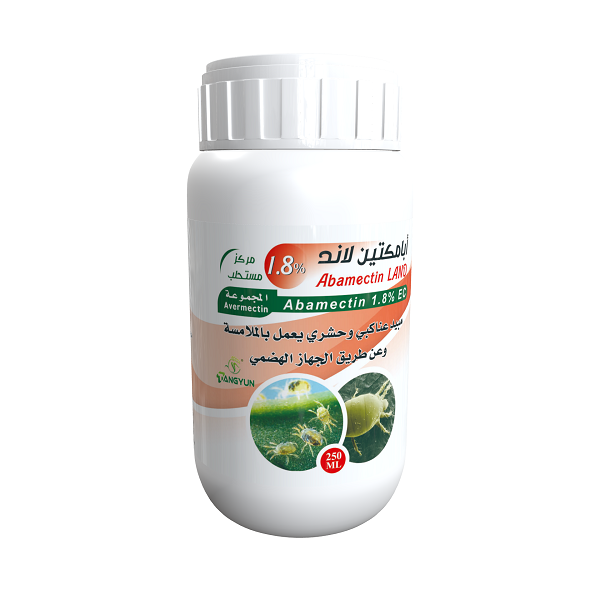
| Abamectin 1.8% EC | Diamondback moth | 420-495ml/ha |
| Abamectin 5% EC | Diamondback moth | 162-216ml/ha |
| Abamectin 2% CS | Rice-leaf roller | 450-600ml/ha |
| Abamectin 5% ME | Diamondback moth | 187.5-225ml/ha |
| Abamectin 0.5% + Fluopyram 1% GR | Root-knot nematode | 22500-30000g/ha |
| Abamectin 7% + Fluopyram 21% SC | root-knot nematode | 1650-2250ml/ha |
| Abamectin 6% + Monosultap 66% WDG | rice leaffolder | 375-495g/ha |
| Abamectin 0.2% + Monosultap 29.8% ME | Asiatic rice borer | 1500-2250g/ha |
| Abamectin 0.3% + Pyridaben 10.2% EC | Red spider mite | 2000-3000-fold dilution |
| Abamectin 2% + Bifenthrin 10% EC | Red spider mite | 3000-4000-fold dilution |
| Abamectin 0.5% + Chlorpyrifos 49.5% EC | Cotton bollworm | 900-1350 g /ha |
| Abamectin 5% + Spirodiclofen 40% SC | Red spider mite | 8000-10000 -fold dilution |
| Abamectin 0.5% + Buprofezin 14.5% SC | greenhouse whitefly | 1000-1500-fold dilution |
| Abamectin 0.5% + Carbosulfan 24.5% EW | Root-knot nematode | 1000-2000-fold dilution |
| Abamectin 3% + Thiamethoxam 21% SC | thrips | 225-300 mL/ha |
| Abamectin 2% + Chlorfenapyr 10% EW | diamondback moth | 375-510ml/ha |
| Abamectin 1% + Chlorfenapyr 14% SC | diamondback moth | 375-450ml/ha |
| Abamectin 1.8% + Acetamiprid 3.2% EC | aphids | 225-375ml/ha |
| Abamectin 1% + Dinotefuran 6% SC | Rice planthopper | 900-1200ml/ha |
| Abamectin 2% + Profenofos 35% EC | rice leaffolder | 750-1125ml/ha |
| Abamectin 0.5% + Clothianidin 0.5% GR | Sugarcane borer | 300-450g/ha |
| Abamectin 4% + Diafenthiuron 20% SC | pear psyllid | 3000-5000-fold dilution |
| Abamectin 0.2% + Cypermethrin 2.8% EC | Cabbage worm,diamondback moth | 450-900ml/ha |
| Abamectin 0.8% + Pyridaben 10% SC | Red spider mite | 2000-2500-fold dilution |
| Abamectin 0.2% + Lambda-cyhalothrin 1.8% EC | Diamondback moth | 750-900ml/ha |
| Abamectin 0.15% + Imidacloprid 3% EC | pear psyllid | 1000-2000-fold dilution |
| Abamectin 0.5% + Beta-cyfluthrin 0.5% GR | stem nematode,grub | 45000-60000g/ha |
| Abamectin 0.3% + Phoxim 34.7% EC | diamondback moth | 600-750 mL/ha |
Application:
1.Cabbage: Apply at peak of egg hatching to early larval stage of diamondback moth. The safety interval is 7 days, and no more than 1 use per growing season .
2.Citrus Tree: Apply at early stage of red spider mite occurrence (2-3 mites per leaf). The safety interval is 14 days, and no more than 2 uses per growing season .
3.Pear Tree: Apply at early larval stage of psyllid (1-2 instars). Dilute 2000-4000 times. The safety interval is 14 days, and no more than 2 uses per growing season .
4.Cotton: Apply at peak of bollworm egg hatching. Dilute 750-1500 times. The safety interval is 14-21 days, and no more than 2-3 uses per growing season .
5.Cucumber: Apply at early stage of leafminer or spider mite. The safety interval is 5-7 days, and no more than 3 uses per growing season .
6.Rice: Apply at peak of egg hatching to early larval stage of rice leaffolder. Use 15-20 ml/mu. The safety interval is 14 days, and no more than 2 uses per growing season .
7.Water Bamboo (Jiaobai): Apply at peak of egg hatching to early larval stage of stem borer. Use 13-18 ml/mu. The safety interval is 14 days, and no more than 2 uses per growing season .
8.Strawberry: Apply at peak of egg hatching to early larval stage of beet armyworm. Use 18-23 ml/mu. The safety interval is 7 days, and no more than 1 use per growing season .
Cautions:
Each crop can be used up to 1-3 times per growing season depending on crop type to avoid resistance development. The safety interval varies by crop: 5-7 days for cucumber, 7 days for cabbage and strawberry, 14 days for citrus, pear, rice and water bamboo, and 14-21 days for cotton .
This insecticide is toxic to fish, bees, and silkworms. Do not apply during flowering periods or near sericulture areas. Avoid application near aquaculture ponds and do not clean application equipment in rivers or ponds .
Do not mix with alkaline pesticides such as lime sulfur or Bordeaux mixture. Rotate with insecticides having different modes of action to delay resistance development .
If swallowed, induce vomiting and seek medical attention immediately. Avoid administering drugs that enhance GABA activity (e.g., barbiturates, valproic acid) during treatment


